
Content:
The Next Coup Attempt
Timothy Snyder (04/04/2026)
03/29/2026
Trump tells us that he is chiefly concerned with the permanence of his own comfort and power (think about ballroom and bunker), much of which he will lose when his party is defeated decisively in the midterms. He regularly declares his intention to meddle in the elections. His party backed a bill which would have turned elections into a sham. Trump wants to increase the defense budget by nearly 50% without any review of what the money is for; this is strategic nonsense, and has to be understood as a payoff for the men who, as he imagines, will help him install a dictatorship. Hegseth is meanwhile purging the highest officer ranks of people of principle.
It is up to us to put two and two together: Trump will seek to exploit the war (or the next one) to alter the elections. We bear responsibility for what comes next.
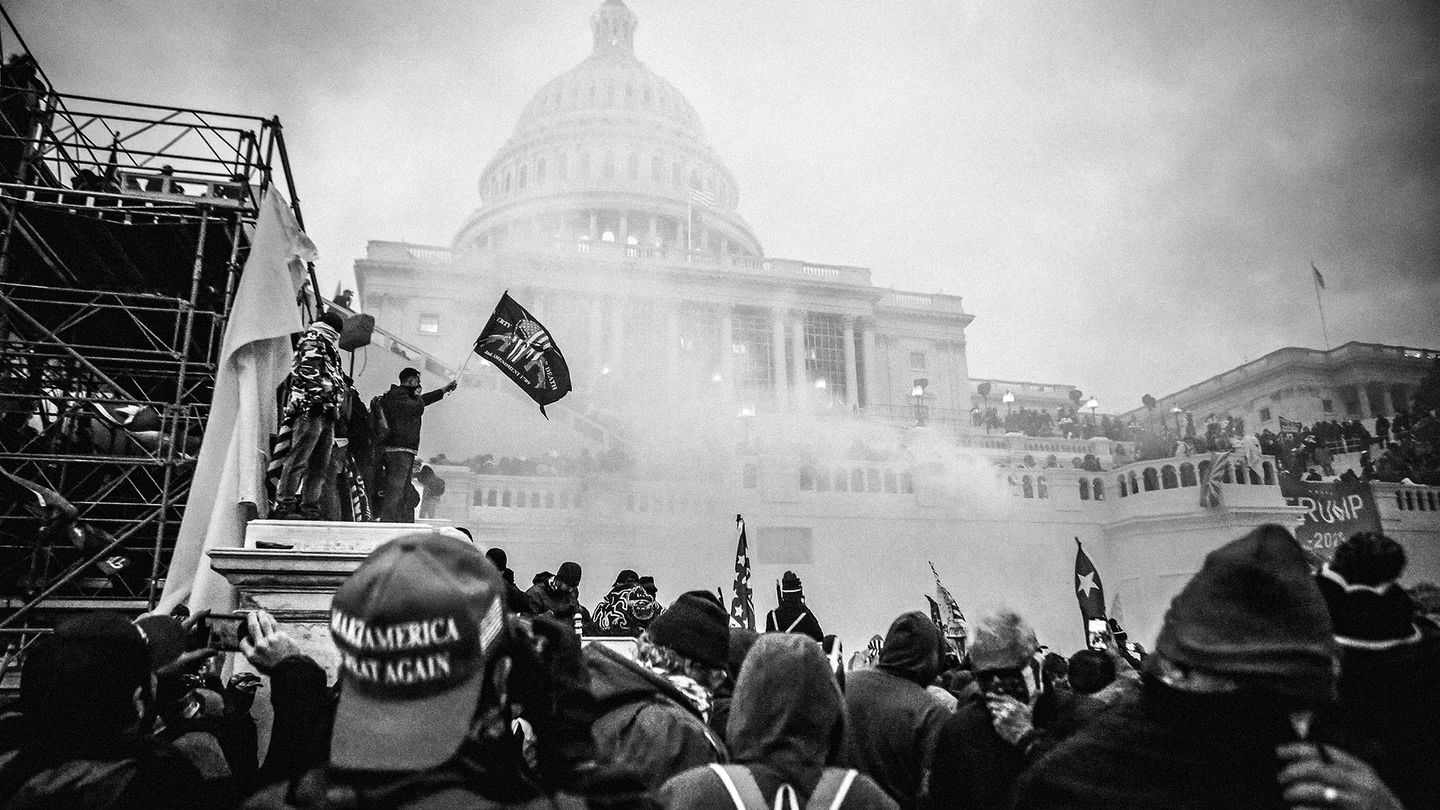
The eventuality can seem frightening, but Trump’s position is weak. The gambit of turning a foreign war into a domestic dictatorship is complicated and difficult. Its success depends on us. If the possibility of such a coup is not anticipated and the variants of the gambit are not called out as they emerge, he can succeed. He has attempted a coup (or, technically, a self-coup) once, in January 2021 — there is no reason to think that he will not try to do so again.
As always, history can help us to imagine the immediate future. History does not repeat, but it does instruct. We know that war offers at least five kinds of opportunities for aspiring dictators. Let us consider the moves that Trump could make, and how they could be stopped. I offer them as five clear types; in practice, of course, they will be mixed and matched from day to day. But if we have the concepts in advance, we can recognize the threat, and turn any sort of coup attempt against Trump.
We are not spectators of this unfolding drama. We are actors inside every scenario. And “we” means journalists who report, judges who follow the law, servicemen and servicewomen who follow the Constitution, and above all citizens who organize, protest and vote. If we know the coup scripts in advance, we know when to take the stage — and where to take the rage.
So here are the scenarios:
1. The Steady Hand. A war is going on, is the claim here, and so we should not change leadership, regardless of what happens in an election. This stance nicely dodges the questions of whether the war was worth starting in the first place, and whether the people in charge are the best qualified to make war (or peace). The steady hand argument has been used countless times; it was the approach that George W. Bush took against John Kerry in the presidential campaign of 2004. But whereas Bush was using such arguments to win an election, Trump will have to use them to overturn the results of an election that his party loses, most likely by huge margins. Given that Trump’s polling on the war is terrible, he is in a weaker position than Bush was, and would have to do much more. It is unclear why a steady hand would rig elections; and, for that matter, Trump’s conduct during this war has made his hand seem (even) less steady. To rig an election, he needs a tight elite consensus around him; he needs allies who are willing to break the law and the Constitution, risking not only prison time but also historical infamy as people who wanted to end the republic. The war is breaking up that consensus and leading to the firing of some of the likely election riggers. The case for a steady hand that should not be hindered by electoral results should be easy to defeat; but we have to see the logic and work to break the ranks of Trump allies who would follow orders to rig elections. They have to know that they will fail and that when they will bear the consequences for the rest of their lives. The one truly steady hand is that of justice.
2. Bonapartism. In this tactic the aspiring dictator says: I know that you would like democracy at home, and so let us prove our ardor together by fighting a war for democracy abroad. This is meant to allow the tyrant to claim the mantle of democracy even while he undoes it at home. This approach was behind the original Napoleonic wars; it was perfected by Napoleon III in the 1850s as “diplomatic nationality.” Trump, however, is not pretending to care about democracy. He prefers dictators; and among dictators, he prefers Putin more then the rest. Trump’s allies though will make the case that war spreads “the American way” or something of the sort. But such arguments can be easily defeated. Whether by insider trading, political bets, arms dealing or (in Putin’s case) higher oil prices and conveniently dropped sanctions, the people around Trump are making money on this war — they are literally warmongers. What is good in America is bled away in this war; as oligarchs foreign and domestic make billions of dollars, as we are asked to sacrifice everything in exchange for nothing. Trump himself ran for office on an anti-Bonapartist platform: no wars abroad for democracy, spend money instead at home. Instead he is proposing to defund basic domestic services in order to the bribe the armed services with a ridiculous funding increase during a senseless war.