
Content:
‘I love Hitler’: Leaked messages expose Young Republicans’ racist chat
Politico
10/14/2025
NEW YORK — Leaders of Young Republican groups throughout the country worried what would happen if their Telegram chat ever got leaked, but they kept typing anyway.
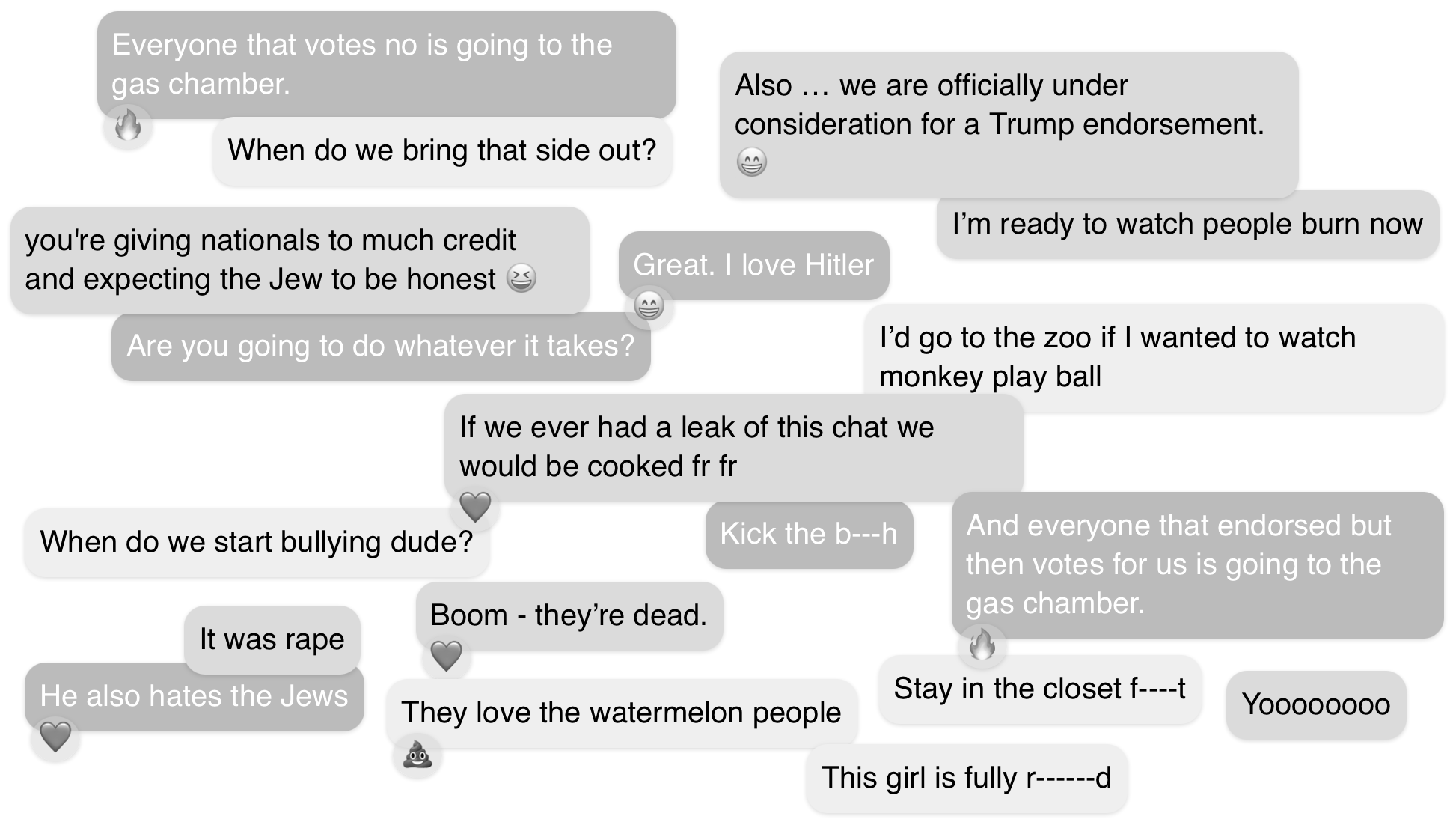
They referred to Black people as monkeys and “the watermelon people” and mused about putting their political opponents in gas chambers. They talked about raping their enemies and driving them to suicide and lauded Republicans who they believed support slavery.
William Hendrix, the Kansas Young Republicans’ vice chair, used the words “n–ga” and “n–guh,” variations of a racial slur, more than a dozen times in the chat. Bobby Walker, the vice chair of the New York State Young Republicans at the time, referred to rape as “epic.” Peter Giunta, who at the time was chair of the same organization, wrote in a message sent in June that “everyone that votes no is going to the gas chamber.”
Giunta was referring to an upcoming vote on whether he should become chair of the Young Republican National Federation, the GOP’s 15,000-member political organization for Republicans between 18 and 40 years old.
“Im going to create some of the greatest physiological torture methods known to man. We only want true believers,” he continued.
Two members of the chat responded.
“Can we fix the showers? Gas chambers don’t fit the Hitler aesthetic,” Joe Maligno, who previously identified himself as the general counsel for the New York State Young Republicans, wrote back.
“I’m ready to watch people burn now,” Annie Kaykaty, New York’s national committee member, said.
The exchange is part of a trove of Telegram chats — obtained by POLITICO and spanning more than seven months of messages among Young Republican leaders in New York, Kansas, Arizona and Vermont. The chat offers an unfiltered look at how a new generation of GOP activists talk when they think no one is listening.
The 2,900 pages of chats, shared among a dozen millennial and Gen Z Republicans between early January and mid-August, chronicle their campaign to seize control of the national Young Republican organization on a hardline pro-Donald Trump platform. Many of the chat members already work inside government or party politics, and one serves as a state senator.
Together, the messages reveal a culture where racist, antisemitic and violent rhetoric circulate freely — and where the Trump-era loosening of political norms has made such talk feel less taboo among those positioning themselves as the party’s next leaders.
“The more the political atmosphere is open and liberating — like it has been with the emergence of Trump and a more right wing GOP even before him — it opens up young people and older people to telling racist jokes, making racist commentaries in private and public,” said Joe Feagin, a Texas A&M sociology professor who has studied racism for the last 60 years. He’s also concerned the words would be applied to public policy. “It’s chilling, of course, because they will act on these views.”
The dynamic of easy racism and casual cruelty played out in often dark, vivid fashion inside the chats, where campaign talk and party gossip blurred into streams of slurs and violent fantasies.