
Content:
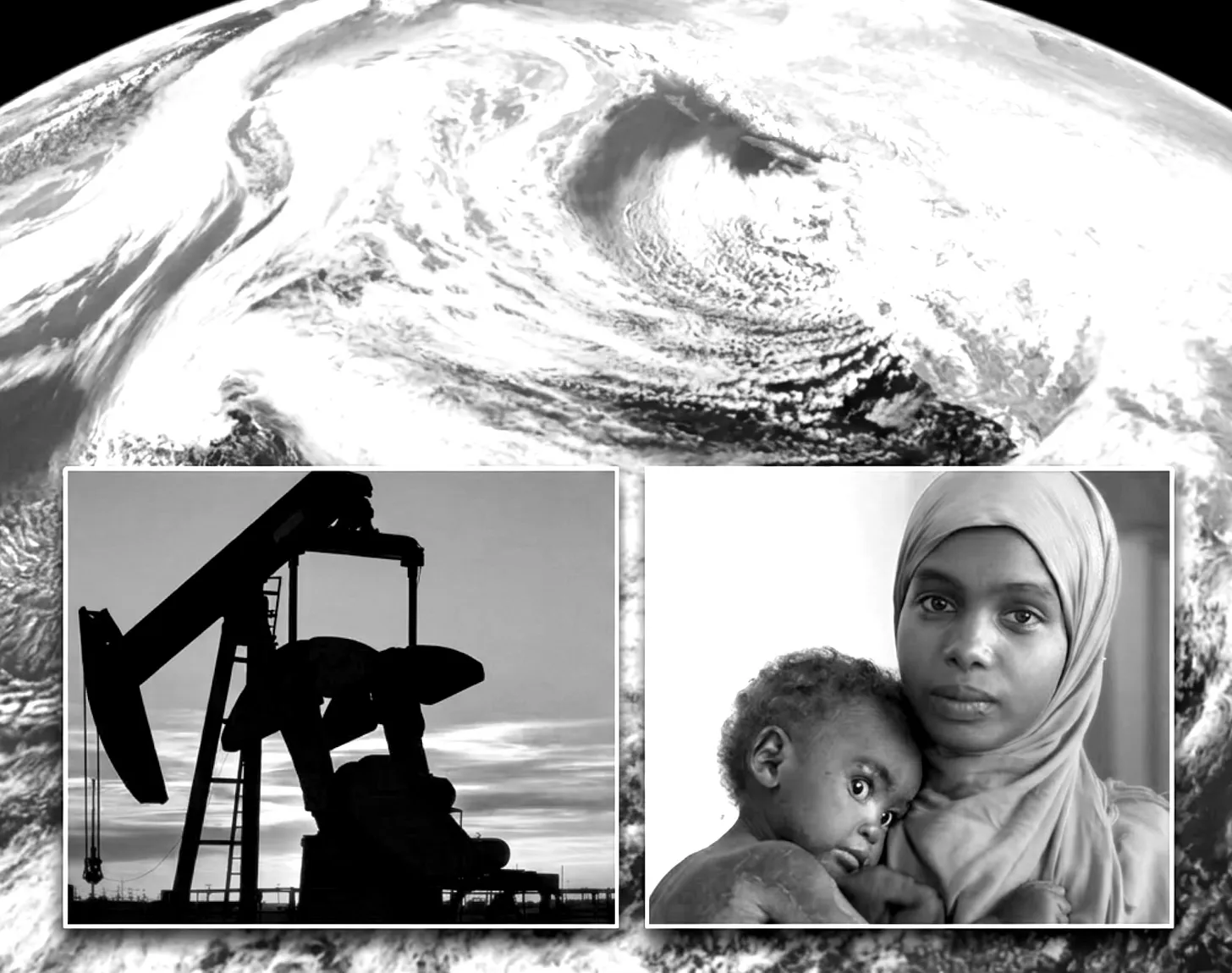
A Ticking Time Bomb: War and Climate Are About To Collide
Resistance Media
04/16/2026
“Polycrises arise when concurrent shocks and interconnected risks combine to create a crisis even worse than the sum of its parts.” – Cambridge Dictionary
We are facing a deadly collision of global events: the reality of global warming acceleration combining with a severe disruption in the supply of fertilizer and its inputs during key planting seasons. The result could be a dramatic escalation of food insecurity, hunger, and famine around the world.
The European Centre for Medium-Range Weather Forecasts gives a 98% chance of El Niño forming by August 2026, an 80% chance it will be strong, and a 20–25% chance it reaches “super” status, an event that has only happened three times since 1980.
This powerful weather phenomenon is taking shape at the same time the Iran war has cut 40% of global fertilizer exports. The compound effect has no modern precedent.
The baseline math is sobering. According to the UN World Food Programme (WFP), 318 million people around the world are already living in acute food insecurity. The agency is now estimating that an additional 45 million could be forced into that same food insecurity threshold if the Iran war continues into June.
Neither of these estimates take into account the looming climate disruption of El Niño nor include a single climate driven crop failure.
This crisis is forming at the same time international food relief organizations have been decimated by DOGE’s U.S Agency for International Development (USAID) cuts and Trump is withholding over $4 billion in back dues from the UN.
The Hormuz blockade’s most lasting damage may not be felt in energy markets, which adjust relatively quickly in comparison to agricultural production, which operates on a fixed biological calendar. Unlike oil, the fertilizer sector has no internationally coordinated strategic reserves, making supply disruptions far more difficult to respond to.
El Niño: The Science and the Stakes
The weather pattern known as El Niño has been transforming the Earth’s climate for hundreds of millions of years. It originates in the tropical Pacific Ocean, where winds usually blow from east to west, pushing warmer water and stormy weather away from South America. When those winds weaken, the warmer water moves east and with it, storms.
During a super El Niño, those effects intensify, last longer, and reach farther. Surging ocean temperatures generate chain reactions: record-breaking heat, extreme storms, droughts, floods and widespread disruptions to agriculture and water systems across the world’s most food-vulnerable regions.
What the strength and duration of this new weather pattern will be is unclear and widely debated by scientists.
Chinese and Brazilian media are treating the evolving situation as an agricultural emergency, while English-language outlets bury it as just another weather forecast.
Each El Niño event in recent decades has gotten steadily worse, because each one drives the temperature to a new record. That’s because each is superimposed on a higher baseline temperature that comes with the steady warming of the planet. As James Hansen and his team pointed out in a paper last week, the expected low temperature at the close of the La Niña this spring is expected to be about 1.4 degrees Celsius above pre-industrial temperatures, which is higher than the maximum from the last El Niños. We are ever further into the great overheating.
The 2015–16 super El Niño occurred without any simultaneous fertilizer supply crisis, with USAID and FEWS NET fully operational, and still pushed an estimated 60 million people into food insecurity.
“El Niño events are estimated to affect crop yields on at least a quarter of global croplands,” Weston Anderson, of the Famine Early Warnings System Network (FEWS NET) warned during the last major El Niño. “And while there’s uncertainty in how crop yields will be impacted this year, because they vary from one El Niño event to another, we know how the dice are loaded.”
War, Fertilizer, and the Closing Planting Window
Nearly half of the world’s traded urea, the most widely used fertilizer, and significant amounts of other fertilizers and their inputs are exported from the Gulf via the Strait of Hormuz. With the blockade and the blockade of the blockade, transit has virtually halted.
Recent disruptions to gas supplies have forced fertilizer plants globally, which use natural gas to manufacture fertilizer, to shut or reduce their output.
Any closure of the Bab el-Mandeb Strait by the Houthis in the Horn of Africa would have further devastating impacts. Deadlines are converging: U.S. planting in April, Indian urea depletion in May, El Niño’s emergence in May–August, Brazil’s soy planting in September, and El Niño’s peak in October–December.
India’s Kharif season, the monsoon planting cycle in June and July that is harvested in October, is now in jeopardy. With critical planting decisions in East Africa and South Asia fast approaching, fertilizer not applied during this window cannot be replaced later in the season.
Governments from Spain to Ghana have already rolled out emergency subsidies, with India approving a $4.5 billion fertilizer support package and Spain releasing 500 million euros for its farmers.
The crisis is cascading: China has now restricted its own fertilizer exports, which means that agricultural producers that source from China rather than the Gulf are now in trouble.
David Miliband, President and CEO of the International Rescue Committee warns:
The war in Iran has unleashed a triple emergency: a surge in humanitarian need, a global economic shock, and a system already stretched to breaking point by more than 60 simultaneous conflicts. The IRC is warning today of a ticking food security timebomb: if the Ukraine shock drove hunger to record highs within weeks, what is now unfolding threatens to be exponentially worse. The window to avert a massive global hunger crisis is rapidly closing.
As the New Statesman put it: “What would manifest as a price shock in the Global North would devolve into a food shortage crisis in import-dependent regions in the Global South.”
International Hunger, Institutional Collapse, and DOGE
Institutional capacity to respond to this crisis has been deeply compromised. USAID was the world’s largest single donor to food aid, contributing $4.5 billion directly to WFP in 2024, nearly half its entire annual budget. DOGE cut 80% of USAID programs in early 2025; global government to government aid fell 23% that year, the largest single-year drop on record.
The DOGE cuts dismantled exactly the infrastructure – WFP funding, therapeutic food supply chains, Food for Peace, Feed the Future – capable of preventing this crisis from descending into full-scale famine.
Perhaps most criminal, in January 2025 DOGE shut down the US-funded Famine Early Warning System Network (FEWS NET), eliminating the primary tool that the WFP, UN, and governments worldwide have relied on to detect famines before they kill. The program, which has saved over one million lives, provides critical and time-sensitive data to decision-makers, providing a critical early warning.
In June 2025, the organization restarted operations, with reduced staff, diminished coverage, and no guarantee of long-term funding.
Abby Maxman of Oxfam: “We have run out of words to describe the depths of suffering we have witnessed after President Trump took a sledgehammer to U.S. humanitarian assistance and the entire global aid system. We are seeing years of progress unravel, and more children suffer and die preventable deaths because of these cuts.”
Food Insecurity in America
The 2024 USDA Household Food Security report confirmed that 47.9 million Americans, 1 in 7 households, lived in food-insecure conditions, including 14.1 million children. The report found food insecurity rates were 24.4% among Black households, 20.2% among Latinx households, and 36.8% among single-mother households. These numbers were rising before Iran war grocery price increases began.
The One Big Beautiful Bill Act enacted the deepest cuts to SNAP in its 60-year history: $186 billion over ten years, eliminating an estimated 6 billion meals per year and removing benefits from 22.3 million American families. The Trump administration has terminated the USDA’s annual Household Food Security survey, eliminating the primary tracking tool at precisely the moment cuts and rising prices are expected to drive food insecurity sharply higher.
The USDA has cut over $1 billion in funding for food banks and school nutrition programs in 2025, removing funding that supported local food providers. Major cuts include $500 million from The Emergency Food Assistance Program and $660 million from the Local Food for Schools program, reducing available healthy options for families, seniors, and children.
According to a ProPublica investigative project, “The cancellation of these deliveries comes at a critical time for food banks. Food insecurity is higher than at any time since the aftermath of the Great Recession, according to federal data, and many food banks are reporting higher need than they saw at the peak of the pandemic.”
Responses: What Must Be Done
The most promising immediate initiative is UN Secretary-General António Guterres’s proposed “Operational Mechanism for the Strait of Hormuz,” modeled on the 2022 Black Sea Grain Initiative, to restart commercial fertilizer trade through the blockade as a first confidence-building step.
The UN’s confidential internal paper states: “The closure of the Strait of Hormuz since 2 March has triggered a critical disruption to global fertilizer supply chains, affecting more than one-quarter of globally traded volumes. This development presents a systemic risk to global food production, particularly in import-dependent regions across Africa and South Asia.”
But a diplomatic corridor alone is insufficient. As Christopher Collins and Thomas Homer-Dixon writing in the New Republic argued: “An effective response demands an integrated playbook. Contingency plans for this summer’s harvests need to simultaneously account for fertilizer shortages and extreme weather. International coordination should extend to fertilizer allocation, not just oil reserves. Humanitarian organizations must prepare for dramatically elevated demand for food aid, and donors need to mobilize now – not after the harvests fail.”
The Food and Agriculture Organization of the UN (FAO) has called for emergency targeted support for farmers facing higher input costs before harvest failures are confirmed. Longer-term, the crisis makes an overwhelming case for accelerating the transition to green ammonia produced from renewable energy and the use of organic fertilizers to heal the soil.
The structural dependency that allowed a single chokepoint to threaten global food security must be reduced. Countries such as Egypt, Vietnam and the U.K. are accelerating renewable energy deployment to address agricultural exposure to fossil fuel volatility.
As Collins and Homer-Dixon observe, “Defense ministries watch the Strait of Hormuz, agriculture departments track fertilizer prices, climate agencies issue El Niño bulletins, and Treasury officials supervise debt levels. Each institution monitors and tries to manage crises in a single system, but nobody is tasked with modeling and mitigating the consequences when apparently distinct crises converge.”
That is the institutional gap the world must close – before the harvests fail.
Share this post