Content:
Let’s Never Forget Who We Are
Resistance Media (January 19, 2026)
01/31/2026
Mass Nonviolent Civil Disobedience: The Fierce Urgency of Now, Pt. 1/3
We are now faced with the fact that tomorrow is today. We are confronted with the fierce urgency of now. In this unfolding conundrum of life and history, there “is” such a thing as being too late. This is no time for apathy or complacency. This is a time for vigorous and positive action.
― Martin Luther King Jr.
The federal government is occupied territory. The Insurrection Act may be ahead. The possibility of a free and fair election this year is slim.
2026 may be the last window for the American people to act. Every day the fascist movement that has America in its grip continues, it becomes more difficult to remove and end this reign of terror.
We want our country back and our intention must be nothing less than political transformation. We must do it ourselves. From the bottom up.
The MAGA movement will not prevail because force in the end has no moral authority. A tremendous opportunity lies ahead, a chance to heal and rebuild this society in new ways. But to win the right to reimagine an America grounded in the rule of law, social, racial and economic justice, to usher in a true era of environmental stewardship, we are going to have to win this fight and win it now.
How can we win? We must build a nonviolent, mass civil disobedience movement and a hyper-local mutual aid movement simultaneously. These tasks must be interwoven and complementary; each strengthening the other, each requiring the other to succeed. They must act in concert to assert our rights of citizenship, protect those most vulnerable and sustain those on the front lines.
The good news is many have come before us and have shown us ways forward. Turning back tyrants, overthrowing dictators, ending authoritarian rule is something that has been done many times over centuries around the world. But the time is getting late.
Back to the Future
While Henry David Thoreau is widely credited with first using the term “civil disobedience” in 1849, the philosophical case for civil disobedience rests on foundations laid long before Thoreau. Aquinas established that conscience and natural law supersede positive law. Locke argued that government legitimacy depends on protecting rights and that breaching this compact forfeits authority. The Declaration of Independence codified the right to alter or abolish destructive government.
Thoreau’s contribution was to articulate a distinctly American version of civil disobedience emphasizing individual conscience, nonviolent resistance, and deliberate acceptance of punishment. His essay became essential to modern movements—Gandhi explicitly studied Thoreau’s work while developing Indian independence campaigns, and King drew on both Thoreau and Aquinas when defending civil rights activism.
To draw upon that tradition as a central strategic response to the escalating national emergency now upon us is to draw upon one of the richest and most successful tools of protest in America.
Our history holds countless examples of citizens, moved by conscience, coming together in periods of crisis to challenge power and confront injustice. These successful movements have employed nonviolent tactics including strikes, boycotts, sit-ins, mass demonstrations, civil disobedience, non-cooperation, parallel institutions, cultural resistance, and countless other methods. These movements often navigated across multiple sectors simultaneously, disrupting economic, social, and political systems.
In this time of threat, fear and exhaustion, let’s never forget who we are.
We are Harriet Tubman eluding the bloodhounds on her trail. We are Eugene Debs running for president from a prison cell. We are ACT UP chained to the doors of the FDA. We are Philip and Daniel Berrigan burning draft files. We are Julia Butterfly Hill living in a redwood tree named Luna for 738 days. We are Margaret Sanger in jail for starting an illegal birth-control clinic. We are John Lewis bleeding on the Edmund Pettus Bridge. We are I.F. Stone speaking truth to power. We are Cesar Chavez on a 25‑day water‑only hunger strike. We are Renee Nicole Good, armed with only a whistle and her conscience.
The following broad but deeply incomplete list of citizen-led movements teaches us how nonviolent civil disobedience has not been an historical footnote, but rather foundational—proven over centuries to be a powerful path forward, capable of achieving stunning and far-reaching victories against impossible odds (see addendum at the bottom of this post for detailed receipts):
American Nonviolent Civil Disobedience Movements
- Abolition Movement and Underground Railroad (1780s-1865)
- Women’s Suffrage Movement (1848-1920)
- Socialist Movement and Eugene Debs (1901-1920)
- Great Depression Hunger Marches and Unemployed Councils (1930-1933)
- Flint Sit-Down Strike (1936-1937)
- Civil Rights Movement (1954-1968)
- Farm Workers Movement (1962-1975)
- Anti-Vietnam War Movement (1964-1973)
- Gay Rights Movement (1969-present)
- Environmental Movement (1970-present)
- Second-Wave Feminist Movement (1960s-1980s)
- Anti-Nuclear Movement (1976-1980s)
- AIDS Activism/ACT UP Movement (1987-present)
- Occupy Wall Street Movement (2011)
- Black Lives Matter Movement (2013-present)
- Standing Rock Water Protectors Movement (2016-2017)
- March for Our Lives Movement (2018-present)
- No Kings Movement (2025-present)
Tomorrow is Today
Now it is time for us to write the next chapter. Fascism is not at the door of America, it has kicked the door in.
The urgency that is driving this historical moment is now undeniably clear. Blue cities under siege. Unlawful and violent abductions. The suppression of the Epstein files. A new wave of imperialism that is destroying the rule based international order, betraying our allies while strengthening authoritarian regimes. The elimination of critical international humanitarian aid programs. Massive funding for a secret paramilitary force answerable only to one man. The decimation of the civil service sector. The ending of health, science and climate research. The construction of a comprehensive surveillance database of American’s private personal information, powered by AI. The use of tariffs as extortion. The breakneck construction of new ICE detention camps capable of holding 115,00 people. The effort to seize the independent Federal Reserve, which would deliver unchecked economic and financial power. The astonishing public grifting of the Trump family and loyal oligarchs.
If this wasn’t enough, there are three major developments likely to unfold in 2026 that many Americans do not anticipate or understand:
Invocation of the Insurrection Act
Trump has repeatedly said he is considering invoking this act which can only be used in a time of national emergency. He has repeatedly attempted to manufacture false crises to justify doing so. Under the Act, the military could enforce curfews, restrict freedom of movement, conduct warrantless searches and seizures, suppress freedom of assembly, and restrict freedom of speech. Civilians could be detained by military personnel without civilian court oversight. While technically civilian courts and civil liberties would not be “suspended,” the practical effect would be the suspension of constitutional protections in any designated militarized zone.
The memo directs executive departments and agencies to implement “a comprehensive national strategy to investigate, prosecute, and disrupt entities and individuals engaged in acts of political violence and intimidation designed to suppress lawful political activity or obstruct the rule of law.” The memo provides authority for CIA, DOJ, FBI, DHS, IRS, FCC, and the Pentagon to wage a comprehensive and aggressive campaign to identify and punish Trump’s perceived enemies. Civil society organizations of all kinds including philanthropies, donors, independent media and human rights advocates are in the crosshairs.
A Constitutional Crisis Surrounding the 2026 Midterm Election
Beyond voter suppression, extreme partisan gerrymandering, gutting of the Voting Rights Act and aggressive disinformation campaigns lies a deeper threat to a free and fair election. The Insurrection Act could be used to seize voting machines in critical states or to deploy federal troops at polling sites. It is highly likely that whatever the actions of the Trump administration, the electoral results will not be accepted by either side, leaving the results in suspended animation and sparking a constitutional crisis.
Frogs, Chickens and Unicorns
The No Kings marches have been critical public statements bringing us together to affirm we are not alone and showing the country the gathering potential of a sleeping giant.
Larger and larger marches will continue to be an important tactic but will be inadequate to meet the escalating intimidation and violence people are being subjected to. To date, the response to the federal attacks on blue cities has been courageous and inspiring. Experiences in each city, lessons learned and tactics applied, have informed and strengthened the next city targeted.
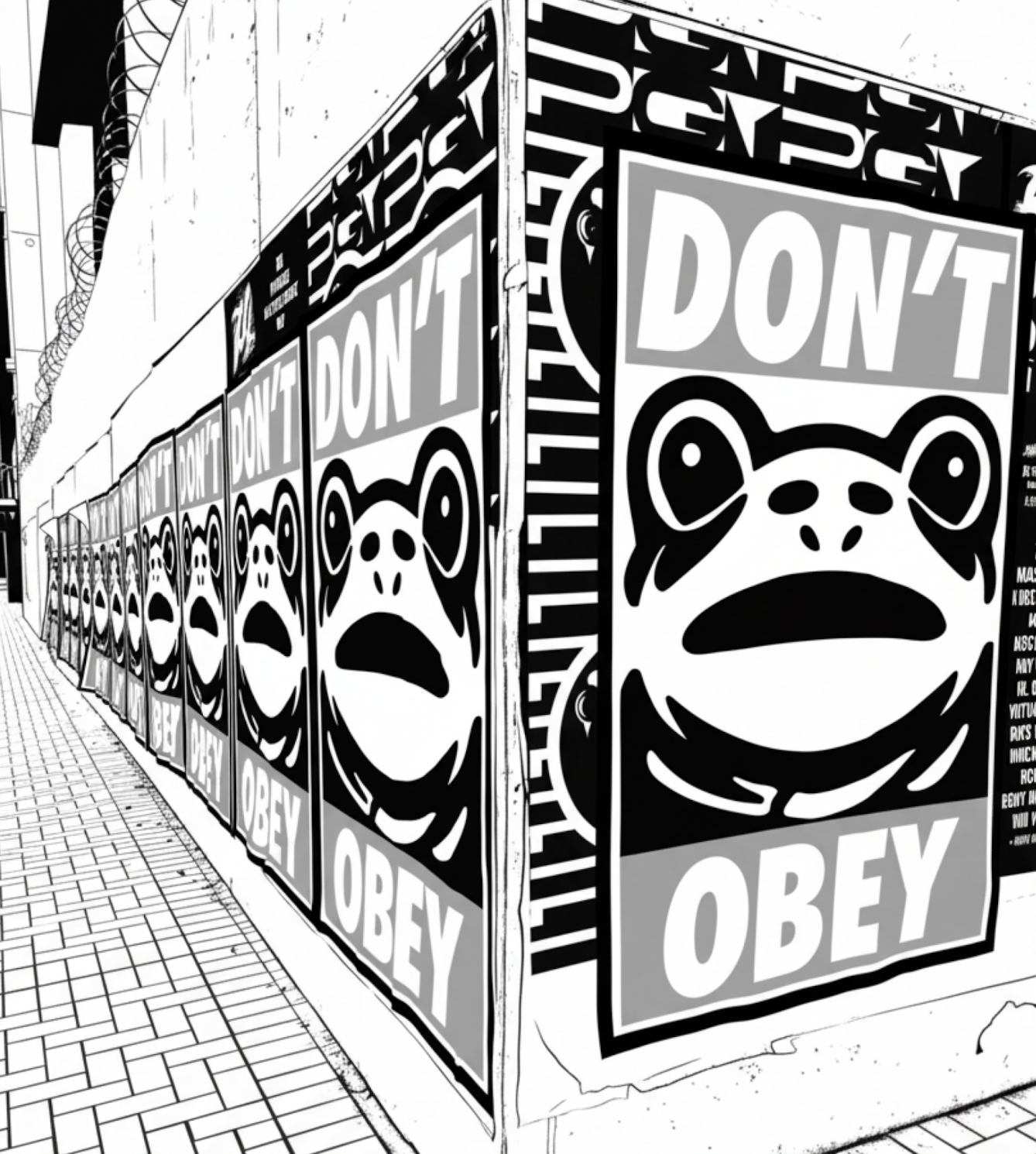
Portland: In response to Trump repeatedly describing their city as “war-ravaged” and overrun by violent extremists, Portland pioneered a tactic termed “tactical frivolity.” Wearing inflatable animal costumes—frogs, chickens, unicorns, dinosaurs, sharks, and dachshunds—to ICE protests. The result made it difficult for authorities to justify aggressive responses (when an ICE agent pepper-sprayed a frog costume’s air intake, the viral video showcased government overreach).
Los Angeles: Los Angeles protestors originated the modern ICE resistance movement through Signal chats and Zoom strategy sessions, with activists monitoring ICE agents in public spaces like sidewalks and Home Depot parking lots starting in 2024, alerting networks whenever they witnessed arrests. They successfully developed spontaneous mass mobilization tactics.
Chicago: Chicago developed a sophisticated community surveillance and rapid-response infrastructure, centered on bright orange whistles distributed by the thousands throughout immigrant neighborhoods. Activist Baltazar Enriquez pioneered the whistle tactic in Little Village, where residents used whistle blasts to warn neighbors of ICE presence, attract observers with cameras, and create enough commotion that agents would sometimes retreat.
Minneapolis: Facing a massive and deadly ICE presence of over 3000 officers, Minneapolis is adopting and evolving as it responds to circumstances other cities have not faced. The murder of Renee Nicole Good and other shootings and assaults by ICE have not had their intended effect—rather than break the protests these acts of violence have mobilized many new activists including those who have never been active before. Tactics include video documentation of ICE activities to ensure accountability, following and tailgating ICE vehicles to slow their movement and alert communities, displaying solidarity signage in homes and “ICE Not Welcome” signs in business windows, and forming human barriers or crowds to physically obstruct arrests without violence. Minneapolis activists have adopted Chicago’s whistle strategy and Los Angeles’ Signal chat infrastructure. After school invasions by ICE, they have established street patrols around elementary and high schools. Art galleries and other neighborhood businesses have transformed into centers to donate and distribute food, medicine, diapers and other urgently needed supplies to those too fearful to leave their homes.
As resourceful and courageous as these responses around the country have been, they are necessarily reactive and defensive in nature. They were developed and implemented in a crisis environment and are a testament to the ingenuity and resourcefulness of the movement. At this stage, however, there is an urgent need for a broader, more aggressive response capable of turning back the tide of violence and disrupting and ending the Trump administration.
Building a More Powerful Resistance
There may be tyrants and murderers, and for a time, they may seem invincible, but in the end, they always fail. Think of it: always.
—Mahatma Gandhi
The Resistance Movement we need now must be characterized by strategic planning, nonviolent training, offensive tactics, organizational coordination, mass participation, mutual aid and information warfare to fight rampant disinformation.
The movement now requires a sophisticated and integrated strategic approach, combining legal challenges, economic pressure, mass mobilization, noncooperation and disruptive, dramatic confrontations. It must embrace a deep commitment to nonviolence, even in the face of murderous violence, that can demonstrate that unarmed citizens, acting collectively with discipline and determination, can dismantle systems that appear invincible.
Resistance must be collective. We must assert not only our individual rights, but economic, social and political rights — without them we are powerless. Resistance means organizing to disrupt the machinery of commerce and government. It means preventing arrests by patrolling neighborhoods to warn of impending ICE raids. It means protesting outside detention facilities. It means strikes. It means blocking streets and highways and occupying buildings. It means providing photographic evidence. It means sustained pressure on local politicians and police to refuse to cooperate with ICE. It means providing legal representation, food and financial assistance to families with members detained. It means a willingness to be arrested. It means a nationwide campaign to defy the state’s inhumanity.
Never before has there been a situation where a well funded, highly organized fascist movement has captured the federal government. The goals at this time in American history must be to restore democracy by removing these elements from governance and holding them criminally accountable for their many crimes.
That means the stakes have never been higher and the nature of the challenges ahead are unprecedented.
COMING UP NEXT – How We Win: The Fierce Urgency of Now, Pt. 2/3
Addendum:
The Receipts: How Nonviolent Movements for Social Change Have Won
Abolition Movement and Underground Railroad (1780s-1865)
An estimated 100,000 enslaved people escaped via a secret network of abolitionists who risked federal prosecution by hiding runaways in defiance of Fugitive Slave Laws, with Harriet Tubman making approximately 13 trips into Maryland between 1850-1860, personally leading about 70 people to freedom and earning the nickname “Moses.” Dramatic rescues like the February 15, 1851 Shadrach Minkins liberation in Boston and the October, 1851 William Henry rescue in Syracuse sparked Northern juries to refuse convicting abolitionists, contributing to a wedge between North and South that led to the Civil War and slavery’s ultimate abolition.
Women’s Suffrage Movement (1848-1920)
Alice Paul’s National Woman’s Party organized the Silent Sentinels, over 2,000 women who picketed the White House six days weekly from January, 1917 to June, 1919, with nearly 500 arrested and 168 serving jail time, maintaining nonviolent discipline while enduring brutal force-feeding, the November 14-15, 1917 “Night of Terror,” of guards beating women at the Occoquan Workhouse. The shocking images of government brutality against peaceful protesters pressured President Wilson to support the Nineteenth Amendment, ratified August 26, 1920, granting women voting rights.
Socialist Movement and Eugene Debs (1901-1920)
Led by Eugene V. Debs, the Socialist Party of America pioneered nonviolent political organizing and labor agitation from 1901-1920, rejecting sabotage and violence while deploying ballot-box politics, industrial unionization, and mass political education that drew nearly 1 million votes in both the 1912 and 1920 presidential elections, elected 2 U.S. Congressional representatives, over 70 mayors, and numerous state legislators and city councilors before being decimated by government repression during World War I. The Socialist movement influenced the adoption of progressive reforms including the eight-hour workday, collective bargaining rights for unions, equal pay for women, old-age pensions, rent control laws, and public welfare programs that became the foundation of the New Deal in the 1930s.
Great Depression Hunger Marches and Unemployed Councils (1930-1933)
Unemployed Councils mobilized over 700 protests in 138 cities between 1930-1932, with 350,000 participating on May 1, 1930, and 500,000 on February 25, 1931. Employing mass meetings, parades, petitions, and organized eviction resistance, the movement successfully pressured municipal governments to expand relief programs. The December 6, 1932 National Hunger March brought 3,000 marchers to Washington demanding relief, shelter for the homeless, and an end to discrimination, compelling unprecedented federal intervention through New Deal programs that provided relief and employment to millions.
Flint Sit-Down Strike (1936-1937)
United Auto Workers members occupied General Motors’ Fisher Body Plant for 44 days beginning December 30, 1936, defending themselves nonviolently when police attacked using fire hoses to extinguish tear gas, while 150,000 supporters rallied in Detroit’s Cadillac Square. GM capitulated in February, 1937, recognizing the UAW as the exclusive bargaining representative at 17 struck plants, agreeing to an hourly raise and reinstatement of strikers without discrimination, and most importantly granting the right to organize. The strike’s victory inspired a massive wave of labor action, with a total of 4,740 strikes of all types throughout 1937 involving nearly 2 million workers, successfully unionizing key American industry.
Civil Rights Movement (1954-1968)
The movement deployed extraordinary diversity of nonviolent tactics: economic boycotts (Montgomery buses for 381 days), sit-ins (70,000 participants by 1961), Freedom Rides (450 riders), mass marches (250,000 at the March on Washington), and children’s crusades facing fire hoses and police dogs, while maintaining strict nonviolent discipline through systematic training workshops. Four major organizations (NAACP, SCLC, SNCC, CORE) coordinated despite philosophical differences to achieve the Civil Rights Act (1964), Voting Rights Act (1965), and Fair Housing Act (1968), dismantling legal segregation and transforming American democracy.
Farm Workers Movement (1962-1975)
Led by Cesar Chavez, Dolores Huerta, and Larry Itliong, the United Farm Workers emerged from the September 1965 Delano Grape Strike when Filipino and Mexican American farm workers united to demand better wages and conditions, deploying nonviolent tactics including a nationwide grape boycott, a 300-mile march to Sacramento, and Chavez’s 25-day hunger strike in 1968 to reaffirm the movement’s commitment to nonviolence despite growing frustration. The five-year strike ended in July 1970 when major table grape growers signed union contracts affecting over 10,000 farm workers, establishing the first successful agricultural workers’ union in U.S. history and proving that consumer boycotts combined with grassroots organizing could overcome growers who had crushed every previous farm labor organizing attempt for 100 years.
Anti-Vietnam War Movement (1964-1973)
The movement evolved through mass demonstrations (500,000 in New York in April 1967, 50,000 at the Pentagon in October 1967), draft resistance through public card burnings and the October 15, 1969 Moratorium involving millions nationwide, maintaining primarily nonviolent tactics despite provocations. Additional tactics included sit-ins at induction centers, blockades of troop trains, priests destroying draft files, Pentagon Papers whistleblower leaks, guerrilla theater, and veterans publicly returning medals. The sustained nonviolent pressure forced President Johnson not to seek reelection in 1968 and contributed to peace negotiations, bombing suspensions, and withdrawal of American troops.
Second-Wave Feminist Movement (1960s-1980s)
Women deployed diverse nonviolent tactics: the September 7, 1968 Miss America protest, the August 26, 1970 Women’s Strike for Equality bringing 50,000 marchers to New York, infiltration of male-only spaces, guerrilla street theater, sit-ins, and the 1982 hunger strike and chain-in at the Illinois Senate chamber supporting the ERA, pursuing three core goals of abortion rights, equal employment and education, and childcare. The movement achieved the Equal Credit Opportunity Act (1974), Roe v. Wade abortion rights (1973), and Title IX prohibiting sex discrimination in education, though the Equal Rights Amendment remains unratified to this day.
Environmental Movement (1970-present)
On April 22, 1970, an estimated 20 million people participated in the first Earth Day, one of the largest activist events in U.S. history, demanding environmental protections and forcing Congress to create the EPA and pass the Clean Air Act and Clean Water Act within months. Organizations like Greenpeace, Sierra Club, Sea Shepherd and more recently 350.org and Sunrise Movement have pioneered nonviolent direct action including occupying oil rigs, infiltrating corporate meetings, blocking pipeline construction, and coordinating civil disobedience campaigns that exposed environmental crimes, global warming and environmental injustice.
Anti-Nuclear Movement (1976-1980s)
The Clamshell Alliance, formed July 1976 to oppose New Hampshire’s Seabrook nuclear plant, pioneered consensus decision-making and organized mass site occupations requiring mandatory nonviolence training before actions, with over 2,000 protesters nonviolently occupying the construction site on May 1, 1977, resulting in 1,414 arrests and 1,000 refusing bail in solidarity. The sustained nonviolent resistance successfully delayed Seabrook’s construction, influenced Governor Hugh Gallen’s 1978 anti-nuclear election victory, and following the March 1979 Three Mile Island accident helped halt new nuclear plant construction in America.
Gay Rights Movement (1969-present)
The Stonewall uprising on June 28, 1969, was transformed by the Gay Liberation Front into the first Christopher Street Pride March on June 28, 1970, establishing a tradition of peaceful annual resistance that evolved into mass Pride marches growing from thousands to millions. The movement deployed diverse nonviolent tactics including “zaps” confronting politicians, die-ins and street theater by ACT UP, and strategic litigation that achieved United States v. Windsor (2013) striking down the Defense of Marriage Act and Obergefell v. Hodges (2015) establishing marriage equality nationwide, while establishing “Nothing About Us Without Us” as a transformative health policy principle.
AIDS Activism/ACT UP Movement (1987-present)
ACT UP was founded March 12, 1987 and within two weeks disrupted Wall Street’s opening bell to protest AZT’s $10,000 annual cost, resulting in Burroughs Wellcome lowering prices four days later. The movement pioneered dramatic nonviolent tactics including mass “die-ins,” infiltrating and chaining to New York Stock Exchange balconies, and storming FDA headquarters. ACT UP’s confrontational nonviolent “inside/outside” strategy forced the FDA to shorten drug approval processes by two years and made activists central to clinical trial design and drug development.
Occupy Wall Street Movement (2011)
Launched September 2011, Occupy Wall Street spread to over 600 U.S. cities employing decentralized consensus-based decision-making under the phrase “We are the 99%.” Occupy fundamentally reframed discourse around economic inequality through physical occupation of public spaces, civil disobedience at banks and corporate headquarters, the Brooklyn Bridge march (768 arrests), and creative “Occupy Sandy” relief efforts. Though the Zuccotti Park encampment was cleared November 15, 2011, the movement catalyzed the Fight for $15 minimum wage movement that raised wages in 60 cities across 29 states and reaffirmed a decentralized organizing model for contemporary activism.
Standing Rock Water Protectors Movement (2016-2017)
Beginning in April 2016, Indigenous youth and elders organized opposition to the Dakota Access Pipeline, creating the largest gathering of Indigenous peoples in over 100 years with up to 10,000 people from 100+ tribes camping at the Cannonball-Missouri River confluence from August 2016 to February 2017. The movement employed diverse nonviolent tactics including prayer gatherings, marches and civil disobedience occupations. Despite the peaceful, prayerful nature of the protest, water protectors faced military-grade violence from law enforcement and private security, yet the movement’s strategy led the Army Corps of Engineers to deny the pipeline easement in December 2016, establishing Standing Rock as a symbol of Indigenous environmental resistance and tribal sovereignty. In February 2017, the first Trump administration granted the easement and construction resumed.
March for Our Lives Movement (2018-present)
Founded by Marjory Stoneman Douglas High School students immediately after the February 14, 2018 Parkland shooting that killed 17, the Never Again/March for Our Lives movement organized the March 24, 2018 demonstration that brought an estimated 1.2-2 million people to 800+ marches nationwide demanding universal background checks, assault weapons bans, and red flag laws. The student-led movement achieved concrete victories including Florida’s passage of gun control measures raising the purchase age to 21 and establishing waiting periods, over 300 state-level gun safety laws passed since 2018, the defeat of 32 NRA-backed congressional candidates in the 2018 midterms, and passage of the Bipartisan Safer Communities Act in 2022—the first federal gun safety legislation in nearly 30 years.
Black Lives Matter Movement (2013-present)
Started in 2013 by Alicia Garza, Patrisse Cullors, and Opal Tometi after George Zimmerman was acquitted for shooting Trayvon Martin, Black Lives Matter became a national movement following the August 9, 2014 police killing of Michael Brown in Ferguson, Missouri, sparking sustained street demonstrations and eventually involving an estimated 15-26 million people during the 2020 George Floyd protests, making it the largest protest movement in U.S. history. The movement employed nonviolent tactics including sustained encampments, mass marches, “Hands Up, Don’t Shoot” actions, “Say Their Names” vigils, and coordinated campaigns that forced federal Department of Justice investigations, compelled police reform including body cameras and bans on no-knock warrants and helped elect organizers to public office.
No Kings Marches (2025-present)
Organized by a coalition of over 200 progressive organizations including Indivisible, the ACLU, American Federation of Teachers, and MoveOn, the No Kings movement mobilized an estimated 5 million people on June 14, 2025, across 2,000 events in all 50 states, with an additional 7 million participating on October 18, 2025, across 2,600+ events—making them 14 times larger than Trump’s inaugurations. A core principle of all No Kings events is a commitment to nonviolent action, with participants maintaining strict discipline to de-escalate confrontations while using diverse tactics including mass marches, civil disobedience actions, and geographically dispersed community organizing.
Share this post